
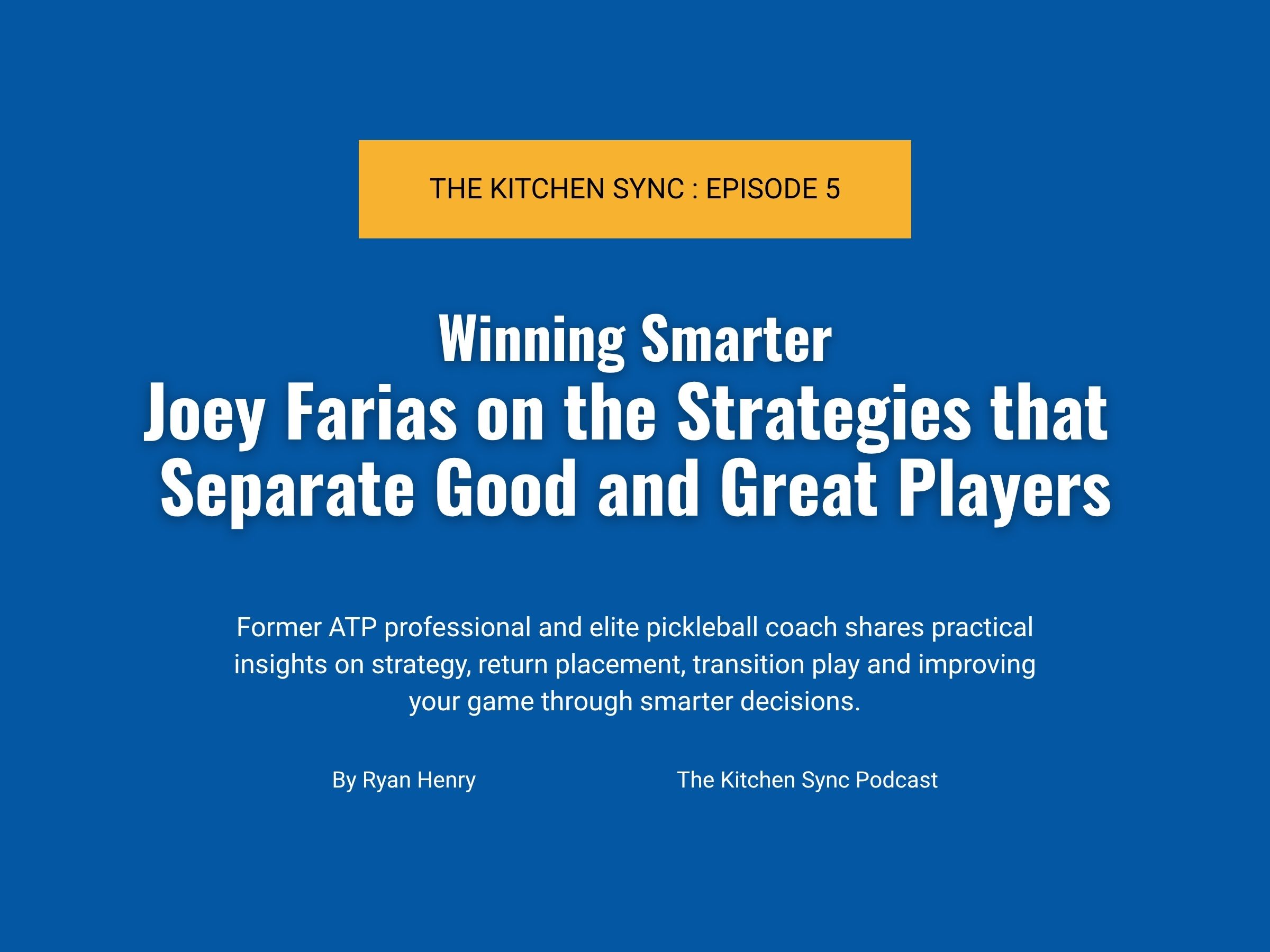
The Kitchen Sync Ep. 5 with Joey Farias [Podcast]
Every pickleball player wants to improve, but what separates good players from great ones?
According to former ATP professional and world-renowned pickleball coach Joey Farias, the answer isn’t always better technique. More often, it’s better decision-making.
In Episode 5 of Kitchen Sync, Ryan Henry sits down with Joey to explore the tactical side of modern pickleball. From return strategy and transition play to recognising patterns and building around your strengths, the conversation provides valuable lessons for everyone, from recreational players to those competing at the highest level.
Having competed professionally in tennis before becoming one of pickleball’s most respected coaches, Joey brings a unique perspective to the game. Today, he works with several of the world’s top-ranked professional players, helping them prepare not just physically, but mentally and strategically for elite competition.
From ATP Tennis to Coaching the World’s Best
Joey’s journey into pickleball began while working as a Director of Tennis in Michigan. Although he had already enjoyed a successful tennis career, the transition into pickleball happened almost naturally.
Early success came quickly. His first professional tournament, the inaugural US Open Pickleball Championships in 2016, resulted in multiple podium finishes, launching what would become one of the sport’s most respected coaching careers.
Today, while he still competes, Joey spends much of his time helping some of the world’s top professionals prepare for tournaments.
Interestingly, he explains that coaching elite players isn’t usually about changing technique.
At the highest level, everyone can execute the shots. The difference lies in recognising patterns, anticipating opponents and consistently making smarter decisions.
Stop Chasing Weaknesses – Build Around Your Strengths
One of the biggest themes throughout the conversation is something many club players rarely consider.
Too often, players spend their practice sessions trying to eliminate every weakness.
Joey believes that approach can actually slow improvement.
Instead, he encourages players to understand what already makes them dangerous and continue investing in those strengths.
Whether it’s a powerful forehand, excellent hands at the kitchen or superior movement, great players learn how to create situations that allow those strengths to influence the match.
That doesn’t mean ignoring weaker areas altogether. Rather, it means maintaining your biggest weapons while gradually improving the rest of your game.
For recreational players, it’s a refreshing reminder that improvement isn’t always about rebuilding everything from scratch.
Sometimes it’s about becoming even better at what you already do well.
Listen to the full episode
Every Return Should Have a Purpose
Most players think about the serve.
Elite players think about the return.
Joey explains that one of the easiest ways to gain an advantage is through smarter return placement.
Rather than simply returning the ball deep, professional players deliberately choose return locations that influence what happens next.
By directing the return into particular areas, they can limit aggressive third-shot drives, influence which opponent plays the next ball and create more predictable patterns for the rest of the rally.
Ryan reflects on this point during the discussion, noting that many recreational players never really consider why they return to a particular spot.
For Joey, every return is part of a larger plan.
It’s not simply about starting the rally, it’s about shaping everything that follows.
Thinking Two Shots Ahead
Another standout moment from the conversation centres around how professional players think ahead during rallies.
Many players focus entirely on executing the perfect third shot.
Elite players often have something different in mind.
Sometimes the third shot isn’t designed to win the point.
It’s designed to create the opportunity to win the point two shots later.
Joey explains how a well-placed drop can move an opponent out of position, allowing a much stronger attack on the fifth shot.
It’s a subtle concept, but one that completely changes how players approach rallies.
Rather than asking, How do I finish this point now?, elite players ask, How do I create a better opportunity on the next ball?
That strategic patience is one of the defining characteristics of high-level pickleball.
Own the Transition Zone
For many intermediate players, the transition zone is simply somewhere they pass through on the way to the kitchen line.
For elite players, it’s an area they actively train to master.
During the podcast, Joey highlights a common habit he sees among developing players, they’re too quick to retreat behind the baseline after hitting a third-shot drop. While it might feel safer, it often gives opponents more space to create angles and apply pressure.
Instead, Joey encourages players to become comfortable defending from the transition zone. By moving forward with balance and preparing for the next ball, players reduce the distance they need to cover and give themselves a better opportunity to reach the non-volley zone.
It’s a subtle adjustment, but one that can dramatically improve consistency during longer rallies.
Ryan also notes that many of the world’s best players now move confidently into the transition zone almost immediately, trusting their ability to defend and work their way forward rather than waiting passively behind the baseline.
Sometimes the Threat Is More Powerful Than the Shot
One of the more fascinating discussions centres on something many players never think about, forcing opponents to respect shots you may only play once or twice.
Joey explains that simply demonstrating the ability to attack down the line or speed up from a particular position changes how opponents position themselves for the rest of the match.
Even if that shot doesn’t immediately win the point, it creates hesitation.
And hesitation creates opportunities.
Professional pickleball is often less about spectacular winners and more about making opponents second-guess their positioning.
Once uncertainty enters the rally, openings naturally begin to appear elsewhere on the court.
Why the Two-Handed Backhand Is Becoming So Important
As the conversation shifts towards technique, Ryan asks Joey about one of the biggest trends currently shaping professional pickleball, the growing use of the two-handed backhand.
Years ago, many elite players relied almost exclusively on a one-handed slice or roll. Today, more professionals are using two hands to disguise attacks and create additional options from exactly the same preparation.
Joey believes that’s where the real advantage lies.
Instead of telegraphing their intentions, players can keep opponents guessing until the very last moment.
A single preparation can produce a dink, an aggressive roll or a speed-up.
That unpredictability makes defending significantly more difficult.
Rather than replacing traditional technique, Joey sees the two-handed backhand as another tool that expands a player’s tactical options.
It’s another reminder that modern pickleball continues to evolve as players search for new ways to create uncertainty.
Keep Improving But Don’t Forget What Makes You Dangerous
Towards the end of the episode, Ryan asks Joey what advice he’d give players looking to improve regardless of their current level.
His answer is surprisingly simple.
Rather than constantly searching for the newest technique or copying every trend on the professional tour, players should continue investing in the parts of their game that already give them confidence.
Too often, players become obsessed with fixing weaknesses while their biggest strengths slowly fade through lack of practice.
At the same time, Joey encourages players to become more complete competitors by gradually developing the areas that make them less predictable.
If you’re naturally aggressive, spend time improving your soft game.
If you’re more patient and defensive, practise recognising opportunities to attack.
Improvement isn’t about becoming someone else’s version of a great player.
It’s about becoming a more complete version of yourself.
Listen to the Full Episode
Catch the full conversation with Sarah Burr on The Kitchen Sync. Available now on Apple Podcasts and Spotify.
Share This
Related Posts